CEO Update – July 31, 2026

Source: US State of Connecticut

Dear Colleagues,

I want to start by thanking each one of you for making UConn Health such a special place to train, teach, provide care, receive care and perform research. This week, I had the privilege of speaking at our Health Sciences and Medical Development fundraising team’s retreat in the Outpatient Pavilion. This group of fundraising professionals is a key part of the UConn Foundation team. As the team continues to grow, this was a valuable opportunity to provide greater insight into UConn Health, our strategic vision, and fundraising priorities.

I enjoyed speaking with this group, as they play an essential role in sharing our story with current and prospective donors. Each time I reflect on and communicate the story of UConn Health’s past, present and future, I am reminded of how far we have come and the exciting opportunities that lie ahead. Our progress is a testament to the hard work, dedication, and commitment of each of you. Your efforts continue to drive our success and advance our mission every day.

At the retreat, I started by explaining what we are as an organization. You’ll notice from the graphic below that we’ve evolved from when we used to only be a public entity.

I also presented a snapshot of the makeup of our public entity which might serve as a refresher for some readers:

As you can see from the graphic above, our total revenues are $2.1 billion, which represents amazing growth over the last decade. What you may not be aware of is that the state portion of our revenues is 8% or $144 million. The rest of the $2.1 billion represents internally generated revenues, with the majority being from patient care. As you can see from the graphic below we internally allocate most of that state revenue to our schools and research with only $10 million of the $144 million going to our clinical enterprise.

You may recall that we have a strategy to eliminate the reliance of the clinical enterprise on state operational support, and we are making headway, as you can see from the chart below, in which the $10 million to the clinical enterprise will become $5 million next year. One important caveat is that we are requesting funding to cover wage increases negotiated at the state level.

Before I leave the topic of the accomplishments each of you has driven over the years, I want to emphasize that no matter your role, you are critical to the mission of UConn Health. For example Dr. Scott Allen, our chief medical officer, sent this email to our facilities leadership this week:

Gentlemen: Each year, the residents who are leaving UConn (almost all are graduating) fill out a survey of their experience at the various hospitals in the Consortium. This year, JDH received the highest score (4.30/5.00) for “Cleanliness and upkeep of facility.” So, please extend a note of appreciation to your staff that maintain JDH in the great condition it is in. This is not just inside the walls of the hospital, but our grounds outside as well.

Of note: we received the highest score last year as well.😊

Scott

Please join me in thanking J.J. Odom, our building and grounds director, and the whole Environmental Services Department.


Along the lines of supporting our employees, we are entering the final week of our 2026 Employee Engagement Survey. So far, 2,454 employees, 46% of our workforce, have participated. Thank you to everyone who has responded. This is meaningful progress, but we are not yet where we need to be to reach our 65% goal.

This week, Jonathan, our Husky mascot, walked an impressive 9.5 miles across UConn Health, visiting employees and departments during our survey engagement tour. Thank you to everyone who welcomed him and helped build energy around the survey. Now, we need to turn that energy into participation.

The number matters because representation matters. Participation remains uneven across UConn Health, particularly among some of our hospital, clinical and frontline teams. We need stronger participation from every part of our workforce if the results are to give us a complete understanding of the employee experience and help us make the right decisions about where improvement is needed.

If you haven’t already done so, please take a few minutes today, if possible, to complete the survey. I’ve completed it and it takes less than 15 minutes, and responses are confidential.

Press Ganey sent a reminder Thursday morning containing your unique link. You may also use the Employee Engagement Survey shortcut on your computer desktop or the QR code on our Take the Survey page.

I would also ask our leaders to make this a priority during the upcoming week: Speak directly with your teams, reach employees across every shift, and provide time and access to complete the survey when operationally possible.

The survey is scheduled to close on Friday, Aug 7. If you have already participated, thank you. If you have not, please take the time now; do not wait. Progress happens together, and we need everyone’s participation to shape what comes next.


This week we announced the arrival of Antoinette Schoenthaler as our new AVP for inclusion and health equity.

Antoinette is coming to us from NYU Langone Health and its Institute for Excellence in Health Equity and brings an impressive record of leadership in advancing health equity and inclusivity across health systems, academic medicine, and national partnerships. She will report to Dr. Jeffery Hines, VP of our Office for Inclusion and Civil Rights, and me, with the charge of working with key stakeholders to advance diversity, inclusion, belonging, and health equity initiatives throughout our organization. Please read more about her on The Hub.

Antoinette is joining us in September. Let’s be sure to give her a warm UConn Health welcome!


I’d like to take a moment to recognize Dr. Peter Schulman, who is retiring after 44 years of service in our medical school and Calhoun Cardiology Center.

Hundreds of students, residents, and fellows have gained from Peter’s wise mentorship, while thousands of patients have benefited from his outstanding patient care. In all ways he is a model to generations of cardiologists. Our institution, our state, and the field of medicine are better off because of him. I invite you to take a moment to read more about Peter and his reflections on his time here on UConn Today.

Please join me in thanking Peter for his legacy of excellence and wishing him the very best in retirement. We certainly will miss him!


I have a wonderful patient letter to share with you to close the week. This was sent to our radiology leadership (edited for privacy):

[Recently] I visited the MSI 1st floor for an imaging appointment and was greeted at the front desk by Tafaria Jackson. She was warm, welcoming, and incredibly efficient, checking me in quickly and making the process seamless.

While I waited for my appointment, I heard her greet each patient who arrived. Even without hearing every conversation, I could “hear” the smile in her voice. She found a genuine way to connect with each person and make them feel welcome. I also noticed her patiently explaining the parking process to several elderly patients and offering a gentleman a wet towel after something had spilled. These small acts of kindness spoke volumes about her attentiveness and kindness.

I wanted to let you know that you have an excellent first point of contact in your department. Tafaria made a great impression, and her professionalism, kindness, and genuine care set a wonderful tone for the entire patient experience. She is truly an asset to your team.


What a fantastic acknowledgement of Tafaria representing UConn Health in such a positive — and noticeable — manner! Thank you, Tafaria, for making such an impact.

And thank you, to everyone reading this, for all you do.

Andrew C. Agwunobi, MD, MBA
Chief Executive Officer
EVP for Health Affairs
UConn Health


Why can’t the shuttle pick employees up at the end of lot MR1 (Munson Road)? It takes half the time of walking to main campus as it does to walk from the lot to the front of the Munson Road building to meet the shuttle. The lack of parking is already an inconvenience.

Good question. As Janel Simpson, our chief administrative officer, explains, the shuttles have designated drop-off and pick-up locations to prioritize pedestrian safety and maintain predictable schedules. These specific stops are selected to minimize potential hazards for pedestrians and assist shuttle drivers in adhering to a reliable timetable, ensuring efficient service.

We appreciate your understanding as we continually assess measures that enhance both safety and timeliness.

There are very large wasps that are flying around the ivy beds surrounding the main hospital. Several of them are harassing people walking out of the buildings. Which department handles insects?

Our building and grounds team oversees pest control and, I’m happy to report, already has taken care of this.

Thank you for bringing it to our attention, and thank you to J.J. Odom, our building and grounds director, for working with our vendor to handle in a timely manner.

Have something you want to ask Dr. Andy? Submit your question on The Hub.

Visit the Hub Now

Note: Unlinked content is only available on The Hub, for which you must be on the UConn Health network to access.

Read about a protein shake found to have benefits for those with Parkinson’s disease.

Dr. Peter Schulman reflects on more than four decades of cardiology and academic medicine at UConn Health.

Plus, we announce the coming arrival of Antoinette Schoenthaler as our new AVP for inclusion and health equityGo to The Hub now for these and other announcements and features and stay up to date with the latest UConn Health news!


Governor Lamont, Senator Blumenthal, Senator Murphy, Congresswoman Hayes, Mayor Sanchez Announce $14.7 Million Grant To Improve Safety and Connectivity in New Britain

Source: US State of Connecticut

(HARTFORD, CT) – Governor Ned Lamont, Senator Richard Blumenthal, Senator Chris Murphy, Congresswoman Jahana Hayes, and Mayor Bobby Sanchez today announced that the City of New Britain has been awarded a $14.7 million federal Better Utilizing Investments to Leverage Development (BUILD) grant from the U.S. Department of Transportation to support improvements at the intersection of Route 174 and East Street.

The improvements will realign the intersection to enhance safety, reduce congestion, improve pedestrian and bicycle access, and strengthen connections to the CTfastrak East Main Street Station.

The corridor is a two-lane roadway that carries approximately 8,000 vehicles per day in both directions. The existing offset intersection will be transformed into a traditional four-way signalized intersection, reducing vehicle conflict points and improving traffic operations. Additional upgrades include new sidewalks, modernized traffic signals, ADA-compliant curb ramps, and streetscape enhancements that will create a safer, more welcoming gateway to downtown New Britain and nearby transit-oriented development.

Construction is anticipated to begin in 2029 and be completed by 2031. The project will be administered by the City of New Britain with support from the Connecticut Department of Transportation.

“We are building the foundation for safer roads and stronger connections that will support future growth in this area,” Governor Lamont said. “By improving access to CTfastrak and supporting nearby transit-oriented development, this project will help create new economic opportunities and bring new energy to the surrounding neighborhood.”

“This funding is a major victory for New Britain and for everyone who travels through this corridor every day,” Mayor Sanchez said. “For years, residents have identified this intersection as one of the city’s most dangerous and frustrating roadways. This grant award allows us to finally address those concerns with a project that will save lives, improve traffic flow, and create a safer, more welcoming entrance to the east side of our city. This is exactly what happens when local, state, and federal partners work together to deliver real results for our community.”

“This $14.6 million federal investment will transform a dangerous intersection into a safer, more welcoming, and efficient gateway for everyone who uses it while strengthening access to CTfastrak and supporting economic growth,” Senator Blumenthal said. “I am proud to have helped deliver this infrastructure funding, which will provide lasting benefits for New Britain, and I look forward to the safer commutes, stronger connections, and new opportunities it will bring to the community.”

“This redesign is about making it safer for auto traffic, but it’s also about making it safer for all kinds of commuters,” Senator Murphy said. “It’s an important, well-designed project and as someone with New Britain roots, I am really excited to come back to see what it looks like when this neighborhood is transformed.”

“This project is a perfect example of what federal, state, and local partnerships can accomplish,” Congresswoman Hayes said. “I am pleased to see the next phase of revitalization move forward through federal dollars I advocated for on behalf of the city. Safer roads and improved commutes will build on the progress made and work to solidify New Britain as a key urban center.”

“Modernizing this outdated Z-curve intersection will make travel safer for the thousands of people who use this corridor every day,” Connecticut Department of Transportation Commissioner Garrett Eucalitto said. “We’re proud to partner with the city on this project to improve traffic flow and create safer connections for drivers, pedestrians, and bicyclists.”

The federal BUILD grant was awarded this month through the U.S. Department of Transportation’s BUILD program, which provides funding for transportation projects that improve safety, mobility, economic opportunity, and quality of life in communities nationwide.

The project is located within New Britain’s East Side Neighborhood Revitalization Zone and supports ongoing transit-oriented development efforts on a 4.6-acre, city-owned property adjacent to the CTfastrak East Main Street Station.

This redevelopment effort is moving forward with support from a $6 million Connecticut Community Investment Fund grant to advance environmental remediation and demolition activities at the site.


UConn Magazine: Andi Duro’s Two Cents

Source: US State of Connecticut

It wasn’t long after graduating from UConn that Andi Duro ’21 (ENG) started to feel overwhelmed by financial anxiety. The New York City–based computer science whiz had left a steady position at a consultancy to take a leap of faith as a freelancer. His days of dependable checks were gone; now he had big payouts followed by months of scraping by.

Though budgeting apps were already widely used to link to users’ bank accounts and provide net worth, they didn’t answer the questions Duro was wrestling with: How did he compare to his peers? How much money should he be saving and investing? Was he doing all the right things for a 20-something? Was it a dumb idea to quit his job and bet on himself? He wondered if existing technology could be used to create a social network where people could have conversations that ­usually feel off-­limits, compare financial pictures, and see the stories behind the numbers.

In December, Duro launched ­twocents, a first-of-its-kind social media app that replaces your username with your verified net worth. In this pseudonymous environment structured similarly to X, Yik Yak, or Reddit, you might come across a user with seven figures in their username whose bio reads “startup founder” or a user with a modest net worth who describes themselves as “into lentils lately.”

Read on for more.

UConn Law Graduates Tackle New Bar Exam

Source: US State of Connecticut

UConn Law graduates sat down to a brand-new bar exam this week, after months – or maybe years, depending on how they look at it – of preparation. Connecticut was one of the 10 jurisdictions to debut the NextGen Uniform Bar Examination with the July 2026 test.

This new exam, developed by the National Conference of Bar Examiners (NCBE), is intended to better reflect the practice of law. The NextGen exam is designed to test more of the skills and knowledge needed in litigation and transactional legal practice, incorporating a broad range of foundational lawyering skills.

According to the NCBE, the exam reflects many of the key changes occurring in legal education, including those in clinical legal education programs, alternative dispute resolution programs, and legal writing and analysis programs. That bodes well for UConn Law alumni.

“I believe our robust experiential education program, innovative first-year Legal Practice program and rigorous upper-level curriculum will position our students well for success on the Next Gen Bar,” Associate Dean for Academic Affairs Molly Land says.

In the fall of 2024, UConn Law students were among those who took a prototype version of the exam, which allowed the school to gather feedback about students’ experience of the new exam and whether they felt their legal education prepared them for the new format. Participants shared that the exam drew heavily on skills they had gained during the real-world learning opportunities that UConn Law offered.

To reflect the practice of law, the NextGen exam relies less on memorization, because in real life lawyers research in real time. It also features integrated practice-based question sets rather than dividing content into discrete subjects, because areas of law often overlap in practice. It also features fewer subjects, which allows students to prepare better.

Preparing for the NextGen bar has been a school-wide priority for the last several years. The faculty explored a range of curricular innovations and Land brought bar company AccessLex on board to offer all graduating students a pre-bar exam course to jumpstart their preparation. The school is also participating in a longitudinal study run by researchers at the University of Cincinnati focused on identifying predicators of success on the new exam and how schools can best support examinees.

“I don’t wish to retake the bar, but I wish this rolled out a couple of years ago,” UConn Law bar success coach Angelica Matos Jennings ’22 says. “My understanding about this bar is that it is a lot more approachable, testing students more on skills they learned and less on how many doctrines can you memorize.”

Jennings joined UConn Law this year to help students prepare for the bar exam, while Professor Mary Beattie stepped back from bar preparation to focus on academic support. Jennings assisted students with both exams, the NextGen, and legacy Uniform Bar Exam (UBE) – since graduates may still take the traditional bar exam in other states and transfer their UBE Score for admission to the Connecticut bar.

Jennings created a HuskyCT site for graduating students with direct links to application materials for UConn Law’s frequently tested jurisdictions, practice questions and essays, and content scope linked on NCBE’s site. She created a similar site for faculty, so they’d have access and exposure to the testing format their students would see. Additionally, she taught a winter course, Applied Analytical Writing – a course pioneered by Beattie – in which students gained exposure and practice in the analytical reading and writing necessary to excel on the exam, and provided advice and testing guidance and essay review through the date of the exam.

Jennings helped students conceptually understand the new integrated questions set structure: what questions are asking, how to move through them, and how to avoid the trap of treating each component in isolation.  Professor Susie Schmeiser joined her in offering students direct feedback on their practice bar exam essays.

The Thomas J. Meskill Law Library has also made efforts to educate students about the legal research portions of the NextGen exam. Research librarians Anne Rajotte, Tanya Johnson, and Adam Mackie all addressed the exam in their Advanced Legal Research (ALR) classes. Johnson also ran sessions in the new library lab to prepare for the research portion of the exam.

“Overall, a lot of what I’m doing is trying to calm students down and make them less afraid of at least this portion of the bar exam,” Johnson says. “For the lab sessions and for ALR, I start by talking about what the exam will be like, the structure of the exam, what types of questions there are, etc., and then I talk in more detail about the research questions.”

Over the summer, alumni and full-time and adjunct faculty members also contributed $1500 to distribute as prizes to students studying for the bar, incentivizing various milestones in their preparation.

While there are challenges in being the first to officially take the new exam, the whole UConn Law community continues to come together to prepare students and graduates for whichever bar exam they choose to take.

Governor Lamont Statement on the Recent Spread of Misinformation

Source: US State of Connecticut

(HARTFORD, CT) – Governor Ned Lamont today released the following statement:

“On July 13, Cooper Whiteside, a Danbury resident and Bridgeport police officer, and Brittany Islami, a New Milford resident and mother of three, were tragically killed in a motor vehicle crash in Danbury. I’ve heard how devoted Officer Whiteside was to his family and how he dedicated his life to helping others even before joining the force. Brittany was a loving mother to three young children who deserved many more years with them. By all accounts, these two people brought joy to the lives of those who knew them, and their loss is profound. My heart breaks for their loved ones, and my thoughts are with them and the Bridgeport Police Department in this time of grief.

“I am grateful that Danbury Police investigated thoroughly and made an arrest in this case. Driving under the influence is unacceptable, and these lives should never have been lost. The accused is entitled to due process, but people who break the law and endanger or hurt others must be held accountable. I hope justice prevails for Officer Whiteside, Brittany Islami, and their families.

“In the days since, online speculation has outpaced the facts. Here is what we know:

  • The woman charged in these deaths has been identified by Danbury Police as Melissa Esperanza Ramirez of Stamford.
  • The Department of Motor Vehicles confirmed she was never issued a driver’s license by the State of Connecticut, and the Secretary of State confirmed she was not registered to vote.
  • Personal information belonging to a New Britain resident who has a similar name and birthdate as the accused, but who has no connection to this case, has been circulated online as if she were the accused.
  • The Danbury Police Department has publicly asked people to stop sharing information misidentifying the New Britain resident as the accused.

“As a result of misinformation pushed in a rush to advance a political agenda, an innocent woman has had her personal details spread across social media and is now facing threats over a crime she had nothing to do with. Social media rewards speed over accuracy, but there are real-world consequences when that habit meets a tragedy like this one. I’m asking everyone, and especially members of the media and elected officials, to slow down and verify information before sharing.

“This misinformation has also been used to cast doubt on the integrity of Connecticut’s elections. That also deserves a direct response: Connecticut’s elections are safe, secure, and accessible. Voter registration and voting are subject to checks at multiple levels. We have bipartisan administration of elections in all 169 towns, paper ballots, rigorous list maintenance, and post-election audits. A procedural lapse in one case, and a case of mistaken identity in another, are not evidence that a system serving 2.4 million registered voters is broken. That overgeneralization defies statistics, facts, and evidence. Connecticut voters should have full confidence in the security of our elections.

“The focus at this time should be on remembering Officer Whiteside and Brittany Islami and allowing their families and communities to grieve. Their tragedy should not be used as a prop to push a false, partisan narrative, and no one should face threats and fear for their safety because online sleuths decided to skip the facts. My hope is that as this case moves through the courts, we can extend both accountability and basic decency to everyone this tragedy has touched.”


Radiology Pioneer Still Teaching at 90

Source: US State of Connecticut

Dr. Harold Moskowitz is 90, losing his vision, and no longer drawing a salary, but, motivated by a “love of teaching,” he still shows up to UConn Health a couple times a week to mentor trainees.

A professor emeritus since his retirement in 2016, Moskowitz primarily gives lectures for first-year radiology residents and students. His time at the UConn School of Medicine goes back to 1969, when he joined the faculty part-time while building the radiology department at Mount Sinai Hospital in Hartford.

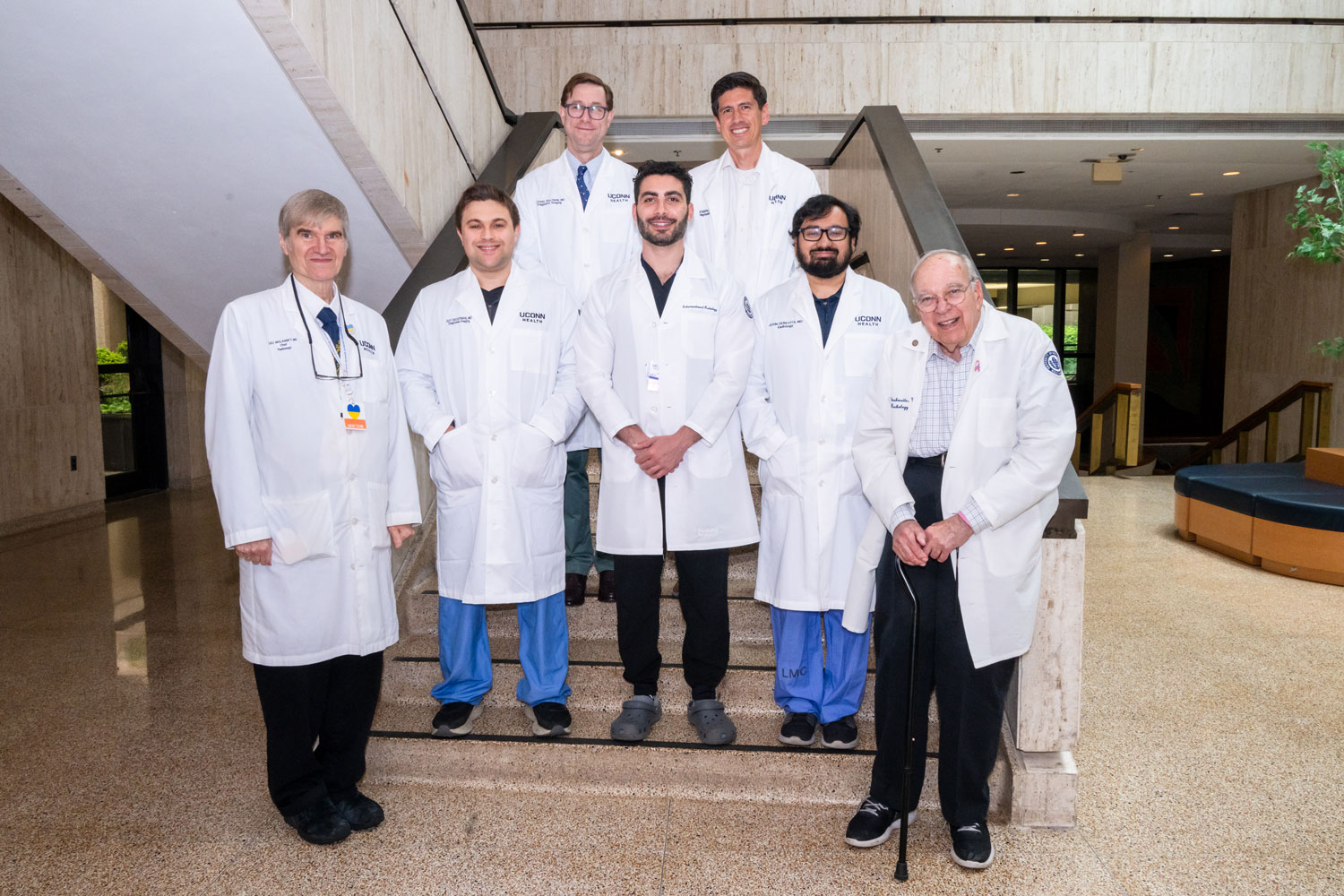
From the UConn Health Department of Diagnostic Imaging and Therapeutics, Dr. Leo Wolanksy (front left), Dr. Michael Baldwin, interim chair (back left) Dr. Timothy Herbst (back right), and Dr. Harold Moskowitz (front right) mentor residents (from center left) Dr. Guy Gechtman, Dr. Nadav Mortman, and Dr. Aakash Jain. (Tina Encarnacion/ UConn Health photo)

“I’ve always enjoyed working with medical students and residents, trying to teach the things that I’ve learned during my career,” Moskowitz says.

“He’s super passionate about radiology and teaching and medicine, and he has such an amazing range of experiences in radiology,” says Dr. Aakash Jain, who recently completed his first year of residency. “He helped pioneer a lot of the foundational parts of radiology and has a lot of interesting stories about that. And then obviously, clinically, he’s seen everything and pretty much done everything. He’s a really great resource.”

Moskowitz estimates he’s read more than 100,000 X-rays.

“I was one of the early angiographers,” Moskowitz says. “I was one of the early people who did mammography, and we’ve saved thousands of people’s lives, and we started the Society of Breast Imaging.”

Today, four decades later, the Society of Breast Imaging has more than 4,200 members and its biannual meeting draws radiologists from around the world.

“He’s really focused on teaching us the fundamentals of radiology,” says Dr. Guy Gechtman, also now in his second year of residency. “Just to hear his perspective on his 60-year-long career in radiology, it’s been great, all the wealth of knowledge and experience that he has to share with us.”

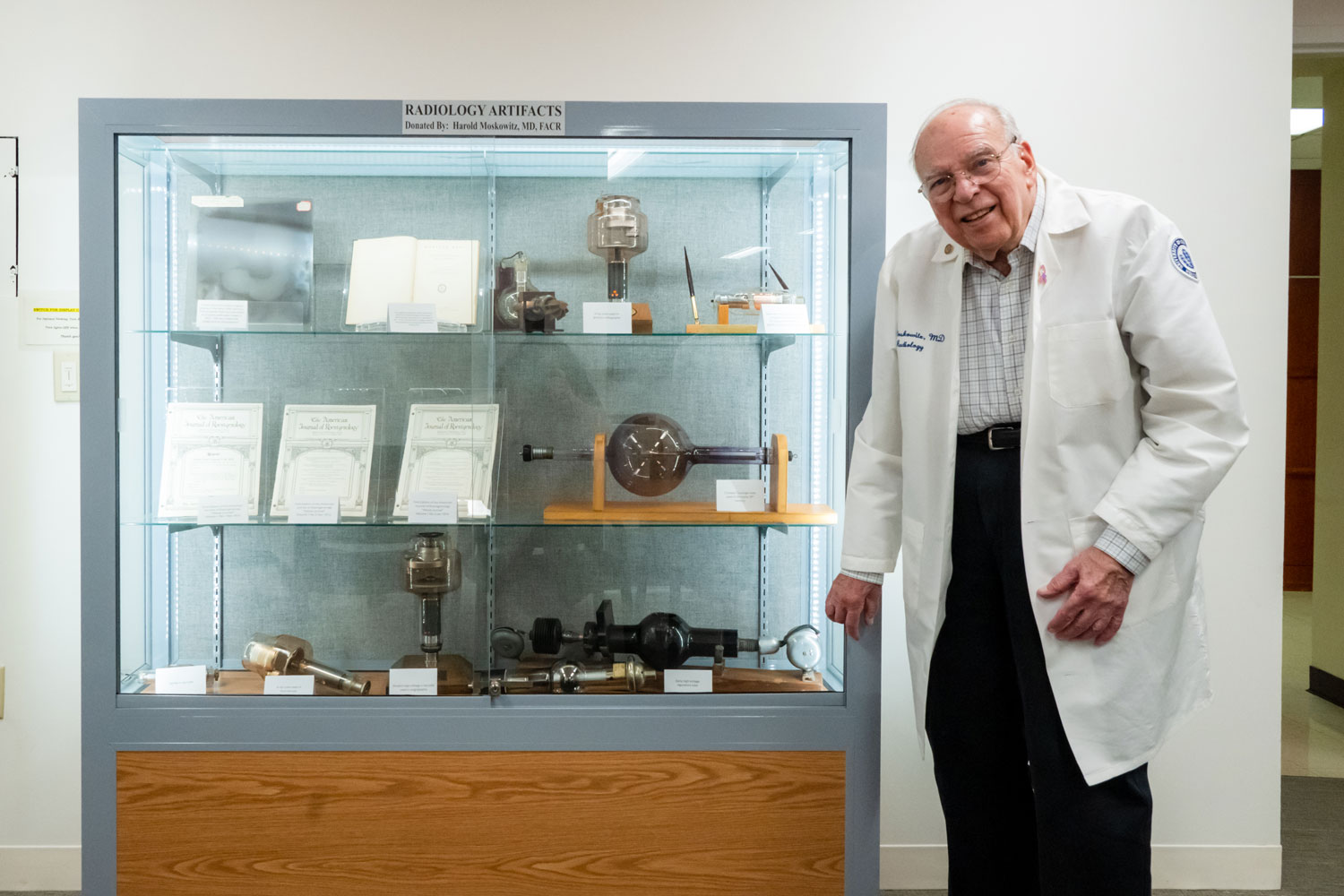
Dr. Harold Moskowitz, UConn School of Medicine professor emeritus or radiology, shows a collection of radiology artifacts he donated to UConn Health. (Tina Encarnacion/ UConn Health photo)

Moskowitz grew up in New York City and graduated from the SUNY Downstate College of Medicine in Brooklyn in 1959. He completed a one-year internship at what was then the Brooklyn Jewish Hospital and a four-year radiology residency at Jefferson Medical College in Philadelphia. He served two years as a medical officer the U.S. Army, stationed on the Japanese island of Okinawa. He then returned to Downstate as a member of the faculty, where he would run the angiography lab at both its new university hospital and nearby Kings County Hospital, from 1966 to 1969.

“Radiology is a driver; because of its ability to look inside the human body, it has a unique perspective, and its growth has been incredible, and the technology is so incredible now,” Moskowitz says. “When I started in radiology, the things we can do today are beyond even my wildest expectations what the future world holds.”

But he notes, with the advances in technology came a diminishing of the interpersonal relationship between physician and patient, especially over the last 10 years, with the COVID-19 pandemic accelerating that trend.

“Today’s resident sits in front of a computer screen and dictates,” Moskowitz says. “When I was training, we often would go out and look and talk to and interview the patient and even potentially examine them to decide what X-ray tests we were going to do.”

Dr. Harold Moskowitz’s history at UConn Health goes back to a three-year stint as a part-time faculty member in 1969. Moskowitz, pictured here in 2007, returned to join the faculty full-time in 2000. (Janine Gelineau/UConn Health Center Photo)

Moskowitz left the UConn School of Medicine faculty in 1972; he returned full-time in 2000, and soon he would establish radiology electives, create a summer radiology rotation for rising second-year students, and, perhaps most noteworthy, retool a struggling radiology residency program.

Dr. Nadav Mortman ’22 MD, a fourth-year resident, recalls his early impression during his first year in the program.

“There is this retired attending who wants to use his free time to come here and teach, and immediately you understand it’s because he’s extremely passionate about radiology, and teaching, and he cares about the future of radiology,” Mortman says. “He teaches not just how to make the diagnosis, but to look at the patient behind the image, as how you would want someone to look at your own family member.”

On the future of radiology, Moskowitz says, “When I started in 1960, we were hand-developing our own X-rays, and now and image is all automated, it’s all on computers, it all can be transmitted anywhere around the world. And artificial intelligence is going to change the whole thing. I think it’s going to take away a lot of the reading from the doctors. AI is going to read the X-rays. It’ll be interesting to see what happens. I hope I’m around to see it. But even now, a significant percentage of X-rays are looked at by AI.”

Moskowitz and his wife, Jan, live in West Hartford, in the house they bought when they moved to Connecticut in 1969. She drives him to UConn Health so he can continue to work.

“It was my calling right from the beginning,” Moskowtiz says. “My wife says that I’m one of the very fortunate people on this earth, because I love my job. I’ve always loved it. I never wanted to retire.”

Earlier this year Moskowitz published his autobiography, “Behind the X-Ray: A Radiologist’s Journey,” available on Amazon.

Curating the 250th: History Professors Mark Country’s Anniversary with Museum Exhibitions

Source: US State of Connecticut

When C-SPAN asks UConn’s Manisha Sinha each year to participate in its ranking of U.S. presidents from best to worst, her favorite – Abraham Lincoln – often comes out on top.

“I’ve read every word he ever wrote,” she says. “I actually have the multivolume set of Lincoln letters on this shelf up here. Before it was digitized, I’d literally get sucked into Lincolnia.”

So, when the Abraham Lincoln Presidential Library and Museum asked last fall if she’d be interested in curating an exhibition, how could she say no? How could she turn down a request to commemorate the 250th anniversary of the start of the American Revolution through the lens of her latest book, “The Rise and Fall of the Second American Republic”?

UConn’s Manisha Sinha, the James L. and Shirley A. Draper Chair in American History, curated the latest exhibition at the Abraham Lincoln Presidential Library and Museum in Springfield, Illinois. (Contributed photo)

Sinha was doing other work while on sabbatical last year from her UConn teaching responsibilities as the James L. and Shirley A. Draper Chair in American History, and she knew a curatorial project in Springfield, Illinois, would be a significant time commitment – especially since it’d be her first.

UConn’s Manisha Sinha, the James L. and Shirley A. Draper Chair in American History, is being interviewed by members of the media at the opening of the latest exhibition at the Abraham Lincoln Presidential Library and Museum in Springfield, Illinois. (Contributes photo)

But it’d be an honor, she told them.

“I do as much as possible whenever people call on me to talk in public or reach a broader audience,” she says. “The New York Times has just asked me to do something for its anniversary this year. I make the time because as historians, we need to reach a broader public. I know more people will read the object identifiers I wrote for the Lincoln exhibition than will read my book, so I didn’t hesitate to say yes.”

“The Second American Revolution” is up through Jan. 17, 2027, and argues the point of Sinha’s latest book: “The refounding of the American republic took place under Lincoln,” she says. “The first republic fell with the secession of the Deep South states and the Civil War. The republic was then re-created with the passage of the 13th, 14th, and 15th amendments, which abolished slavery, gave citizenship rights and equal protections, and extended the right to vote.”

As Sinha’s exhibition considers the shaping of the country post-Civil War, one closer to home centers on the president that sometimes beats Lincoln in C-SPAN’s annual ranking – George Washington – and his contemporaries who declared war on Britain and started it all.

Finding Stories

In “Connecticut’s Revolution,” at the Museum of Connecticut History inside the Connecticut State Library in Hartford, a curatorial team that included State Historian Andy Horowitz, an associate professor of history at UConn, delivers the story of the Nutmeg State circa 1776.

“I learned an incredible amount from the archivists and curators at the museum, the depth of their knowledge and research skill at being able to pull out stories from the archive,” Horowitz says. “There’s a ton of paper in there and the stories are there, but they’re lost unless you have these experts willing to do the often-painstaking work of finding a name in an enlistment record and tracing it to find what rations he was given and where he lived, what happened to his wife, and so on.”

Take for instance, the pocket watch owned by Elisha Bostwick, a New Milford man who crossed the Delaware River with Washington in December 1776. The story might have been lost were it not for collections curator Beth Burgess, who found the watch in a jewelry box that was in storage and pored over military records to authenticate it.

“You’re seeing the good work of a historian and a curator and archivist to put these items into context,” Horowitz says. “Most people are aware of Washington crossing the Delaware because there’s a famous painting of it. This gave the museum an opportunity to tell that story, but to tell it through the story of a common soldier from New Milford.”

Connecticut State Historian and associate professor of history at UConn Andy Horowitz poses for a photo in the Museum of Connecticut History’s “Connecticut’s Revolution” exhibition that he helped curate in Memorial Hall of the Connecticut State Library & Supreme Court Building in Hartford on Wednesday, July 8, 2026. (Sydney Herdle/UConn Photo)

Up until July 9, 2027, “Connecticut’s Revolution” seeks to give visitors what they expect in unexpected ways, Horowitz explains.

The team, headed by museum administrator Jennifer Matos, knew people would want to see the Declaration of Independence, Horowitz says, but the exhibition offers it via the contribution of Mary Katharine Goddard, a New London native who the Continental Congress commissioned to print copies of the Declaration to give to each of the original states.

Connecticut’s copy of the Declaration of Independence printed on Jan. 18, 1777 by Mary Katharine Goddard sits on display in the Museum of Connecticut History’s “Connecticut’s Revolution” exhibition in Memorial Hall of the Connecticut State Library & Supreme Court Building in Hartford on Wednesday, July 8, 2026. (Sydney Herdle/UConn Photo)

Because she was the printer, her name appears on the bottom of each copy – “Hers is the only woman’s name that appears on the Declaration of Independence,” Horowitz notes.

Ask him about his next favorite artifact and Horowitz heads to what looks like simply a chunk of metal under a glass case and debates how to start telling its story.

“Citizens of the new democracy who were moved into a patriotic fervor, or we could just call them an unruly mob,” he starts, pulled down a 4,000-pound gilded statue of King George III in New York City’s Bowling Green, broke it into pieces, and pulled it on carts into Litchfield, where it was to be melted down and eventually repurposed into 42,000 lead musket balls.

Before the group made it into northwestern Connecticut, they stopped overnight in Wilton, Connecticut, and while everyone was asleep, one or more British Loyalists took several chunks and likely buried them for safekeeping, he continues. That piece, the one on display, was found buried in a garden in Wilton nearly a century later.

“What’s so amazing is you get to imagine a Connecticut, where there are Patriots and Loyalists even here in these little towns,” Horowitz says. “It helps you see the story of Connecticut as the Provision State because even then its citizens were well aware of the material value of the lead and the immediate military use it could be put to.

“It’s also a story about history,” he adds. “You have these colonists who had inherited a history they didn’t want anymore, the history of the monarchy, and they transformed that history into a future they wanted to live in. This artifact carries all of that, and that’s why, to me, it’s one of the most moving pieces.”

Grabbing Attention

Over the last year, Sinha and Horowitz worked with professional staffs at both museums to bring their respective exhibitions to life, and they each describe experiences that gave them a deeper appreciation for the past, surreal in some cases.

For Sinha, that was the teeth marks on the pen that Lincoln used to sign the Emancipation Proclamation, an artifact on rare loan from the Massachusetts Historical Society, which used state troopers as escorts to ensure its safe delivery to the Midwest, she says.

“I’m looking at this Emancipation pen, and I’m thinking Lincoln probably put it in his mouth,” she says. “Those are the kinds of things that really blow my mind. It’s a whole different experience seeing these objects and that’s why museums are so important.”

Horowitz agrees.

“There’s an aura to every item,” he says. “To me, the most important tool that a historian has, and also our highest aspiration as historians, is empathy. We want to see the world through somebody else’s eyes. The aura of the original document or the original object helps me with that empathetic aspiration, helps me remember that these are real people. They’re people who could have been me, could have been like me, could have been my neighbors, and it makes them feel more three-dimensional.”

Historical items sit on display in the Museum of Connecticut History’s “Connecticut’s Revolution” exhibition in Memorial Hall of the Connecticut State Library & Supreme Court Building in Hartford on Wednesday, July 8, 2026. (Sydney Herdle/UConn Photo)

Sinha – who recently gained additional prominence when Supreme Court Justice Ketanji Brown Jackson cited her latest book in the justice’s concurrence on birthright citizenship and appeared as an expert on the podcast “Reconstruction: The Unfinished Promise” featuring President Barack Obama – got most of her wish list in the Lincoln exhibition.

She says she wanted the 13th Amendment to the Constitution, the one that abolished slavery, on display. The Library had the original but hesitates to display it often because the ink is fading.

“They created a darkened case, which is shut and if you want to view it, you open the case and then it shuts again,” Sinha says, describing the protections around it.

The exhibition also features blown-up images from her book; a 10-minute film with her explaining the three amendments being discussed; a chair from Ford’s Theatre, where Lincoln was assassinated; and a Red Shirt from the namesake white supremacist terrorist group that sought to overthrow Reconstruction.

The exhibition ends with 75-word biographies of 20 women who were key suffragists and women’s right advocates, think Mary Edwards Walker, an Army surgeon who wore pants; Harriet Jacobs, author of the first female slave narrative, “Incidents in the Life of a Slave Girl”; and Lucy Stone, who kept her maiden name upon getting married giving rise to the moniker “Lucy Stoners” for those who followed suit.

“Portrait of Esther Jackson” by Kern Bruce sits on display in the Museum of Connecticut History’s “Connecticut’s Revolution” exhibition in Memorial Hall of the Connecticut State Library & Supreme Court Building in Hartford on Wednesday, July 8, 2026. (Sydney Herdle/UConn Photo)

“I knew what would grab people’s attention because when I tell these stories to my students at UConn, they sit up in their chairs and really listen,” Sinha says. “When you’re teaching, you’re constantly trying to get your students’ attention. I imagined museum visitors being my average student who knows some American history but probably has no idea about the period you’re talking about in-depth.”

She continues, “I want those who see this exhibition to go away with the notion of active citizenship. If these women and enslaved people fought for their own freedom, then I don’t think we have any excuse now not to be active citizens, to keep ourselves informed, to be aware of our history, and see how our present is informed by the past. I think that’s what history does.”

The Fall 2026 Draper Workshop, organized by Manisha Sinha as the James L. and Shirley A. Draper Chair in American History, will be held Monday, Nov. 16, at 4:30 p.m. in Herbst Hall, Room 101, at UConn Storrs. A panel of experts, including Connecticut State Historian Andy Horowitz, an associate professor of history at UConn, will discuss “The American Revolution: A 250th Appraisal.” The event is open to the public.

Research Development – It Takes a Village

Source: US State of Connecticut

A group of research development leaders from six public research universities across New England, including UConn, has recently been honored with the National Organization of Research Development Professionals (NORDP) Leadership Award. This award recognizes the team’s outstanding contributions to advancing the field of research development. 

The New England Public Research Leaders Collaborative includes representatives from the University of Connecticut (UConn), the University of Massachusetts (UMass), the University of Vermont (UVM), the University of New Hampshire (UNH), the University of Maine (UMaine), and the University of Rhode Island (URI).  

Its members include: 

  • Matt Mroz (UConn)  
  • Dan Riechers (UMass Lowell) 
  • Bethann Valentine (UMass Lowell) 
  • Loren Walker (UMass Amherst) 
  • Jeralyn Haraldsen (UVM) 
  • Michael Thompson (UNH) 
  • Mark Milutinovich (UNH) 
  • Saul Allen (UMaine)
  • Karen Markin (URI) 

“Internally, we refer to ourselves as the NERDs, for ‘New England Research Development’ group,” jokes Matt Mroz, UConn’s interim director of research development. 

The collaborative was officially convened several years ago under the leadership of now-President Radenka Maric, who was serving as the Vice President for Research at the time.  

“It’s a good example of what’s possible when we have leadership that wants collaboration, and will support it, and a group of professionals that understands the value of those connections and will do the work to keep them alive,” says Mroz. 

Mroz, who was a founding member of the group, recalls the initial establishment period as one of forging enduring research connections. While he acknowledges that the research funding landscape can be competitive, he prefers to look at the potential for collaboration and information-sharing across institutions.  

“We realized we had a lot in common with these other New England public universities,” he says. “There was something else there that we hadn’t leveraged. We should talk to one another! So, we started getting this regular group together.” 

The group meets monthly to discuss challenges and opportunities facing public institutions in the region. They also host yearly in-person summits to strengthen connections and dive deeper into tricky problems. 

“We’re continuing to see a growing number of federal funding opportunities that call for regional collaboration, and that’s especially important for public research universities in New England,” says member Jeralyn Haraldsen, director of research development at UVM. “Through our regular discussions, the NERDs have built relationships and trust that allow us to connect researchers, form stronger partnerships, and position our institutions to compete more effectively for opportunities that no single university could compete for alone.”  

With their collective insight, they’ve also innovated new ways to spotlight and advance the vital work of New England RD teams. Together, the group has forged cross-institutional collaborations, shepherded multi-university grant proposals, and produced an economic impact study showing that federal research dollars flowing to their universities generate nearly $1.7 billion in regional economic activity and support over 12,000 jobs across New England. 

This report also revealed that every $10 of federal research expenditure in the region generates an additional $18 of economic activity.  

Statistics like this help the public, as well as funding partners, grasp the immense ripple effects of university research. 

“Public research universities contribute in many ways to the states they serve, often with modest resources,” says member Karen Markin, director of research development at URI. “By joining forces in this collaboration, we can have an even greater impact for our constituencies.” 

New England is a national powerhouse of academic activity, including world-class public universities as well as private institutions like Yale, Harvard, and MIT. However, Mroz notes, this latter category of institution has a different sort of research mission; public universities are unique in their obligation to use their public funding to give back to their surrounding communities and states. This common interest unites the missions of New England public research institutions. 

As a result of their collaboration, these universities can each be “more effective at serving the state,” says Mroz.  

“We’re building collaborations that make us all better. We’re better together rather than as separate competitors,” he adds. “It’s a wonderful thing to be recognized, but the most important thing is to spotlight the cool work that’s happening” in the world of university research development. 

Governor Lamont Applauds U.S. Navy’s Announcement of $76.6 Billion Contract Awarded to General Dynamics Electric Boat

Source: US State of Connecticut

(HARTFORD, CT) – Governor Ned Lamont today released the following statement on the announcement that the U.S. Navy has awarded General Dynamics Electric Boat $29.5 billion for five additional Columbia-class submarines, $42.1 billion for nine additional Virginia-Class submarines, and additional support for shipyard infrastructure:

“This is fantastic news for Connecticut and for Electric Boat. With these multi-year contracts, the Navy has made clear what we’ve known all along: Electric Boat builds the best submarines in the world, and Connecticut has the best workforce in the world to build them. This is a commitment to years of shipbuilding right here in our state, meaning more jobs and growth in our communities. That’s why we’re investing in affordable housing, transportation, and great schools, so that the families moving to the New London area to build the future of our Navy have every reason to put down roots and stay. Congratulations to the men and women of Electric Boat and thank you for your work keeping our country safe.”


UConn School of Pharmacy and Pharmaceutical Sciences Professor Xiuling Lu Receives Director Promotion

Source: US State of Connecticut

Xiuling Lu graduated from Institute of Process Engineering, Chinese Academy of Sciences in Beijing, China with a Ph.D. in Biochemical Engineering in 2005 and joined the University of Kentucky’s Department of Pharmaceutical Sciences in 2006 as a post-doctoral fellow.

Lu moved to the University of North Carolina at Chapel Hill Eshelman School of Pharmacy in 2008 as a research assistant professor before coming to the University of Connecticut School of Pharmacy and Pharmaceutical Sciences’ Department of Pharmaceutical Sciences as an assistant professor in 2011.

In 2017, Lu was promoted to associate professor before becoming a professor in 2022. In 2018, Lu was named the associate director of the Kildsig Center for Pharmaceutical Processing Research for UConn.

Now, Lu will take on a new title and challenge as she will be promoted to the Director of Research and Graduate Education starting in late August. In this important leadership role, Lu will provide strategic direction and coordination for the school’s graduate education and research initiatives.

Xiuling Lu, assistant professor of pharmaceutical science on Dec. 1, 2016. (Peter Morenus/UConn Photo)

Lu has been recognized internationally. She was elected as the American Association of Pharmaceutical Sciences (AAPS) Fellow in 2023, received 19th Annual Women of Innovation Award in Research Innovation and Leadership, Connecticut Technology Council and Connecticut Center for Advanced Technology in 2024, elected as a member of Connecticut Academy of Science and Engineering in 2025, and Controlled Release Society Fellow in 2025.

When asked about the promotion, Lu said that she felt honored and trusted by the school leadership and her peers.

Lu is also excited about certain aspects of her new role.

“I am excited about working more for students, as students are the future,” Lu said. “Equally, I am also excited to promote research collaborations within the school, the University, and the State, nationally and internationally.”

Lu wants to create more opportunities for students to connect outside of the SoPPS, not just at UConn but also across disciplines that an interactive environment provides.

This new director position also helps Lu build on the things she was working on before the promotion.

Specifically, the new Center for Pharmaceutical Manufacturing Modernization (CPMM) which is led by Lu. The CPMM is a way to bring manufacturing back to the United States.

“There is a workforce development shortage, as well as a product pipeline shortage [in the U.S.],” Lu said.

Lu continued.

“The most important thing is to enhance the rapid development of pharmaceutical products in the US, and you need advanced technologies to do that,” Lu said. “The UConn School of Pharmacy and Pharmaceutical Sciences, especially our department, is in a position to do that.”

The focus of the CPMM is to modernize technology and train students and the workforce to fill those shortages.

Lu currently focuses on two types of research. The first involves utilizing a formulation in nanotechnology to enhance cancer treatment for reduced toxicity and more specific deliveries to tumors. Making cancer treatment more effective for those difficult to treat cancers.

The other part of research Lu involves formulation and process development for a variety of products including nanoparticles to help it be commercialized.

This research also earned Lu an award, as she was the 2025 winner of the Michael J. Pikal National Institute for Pharmaceutical Technology and Education Distinguished Scholar Award in Pharmaceutical Processing.

Lu will officially take on the Director of Research and Graduate Education on August 23, 2026.